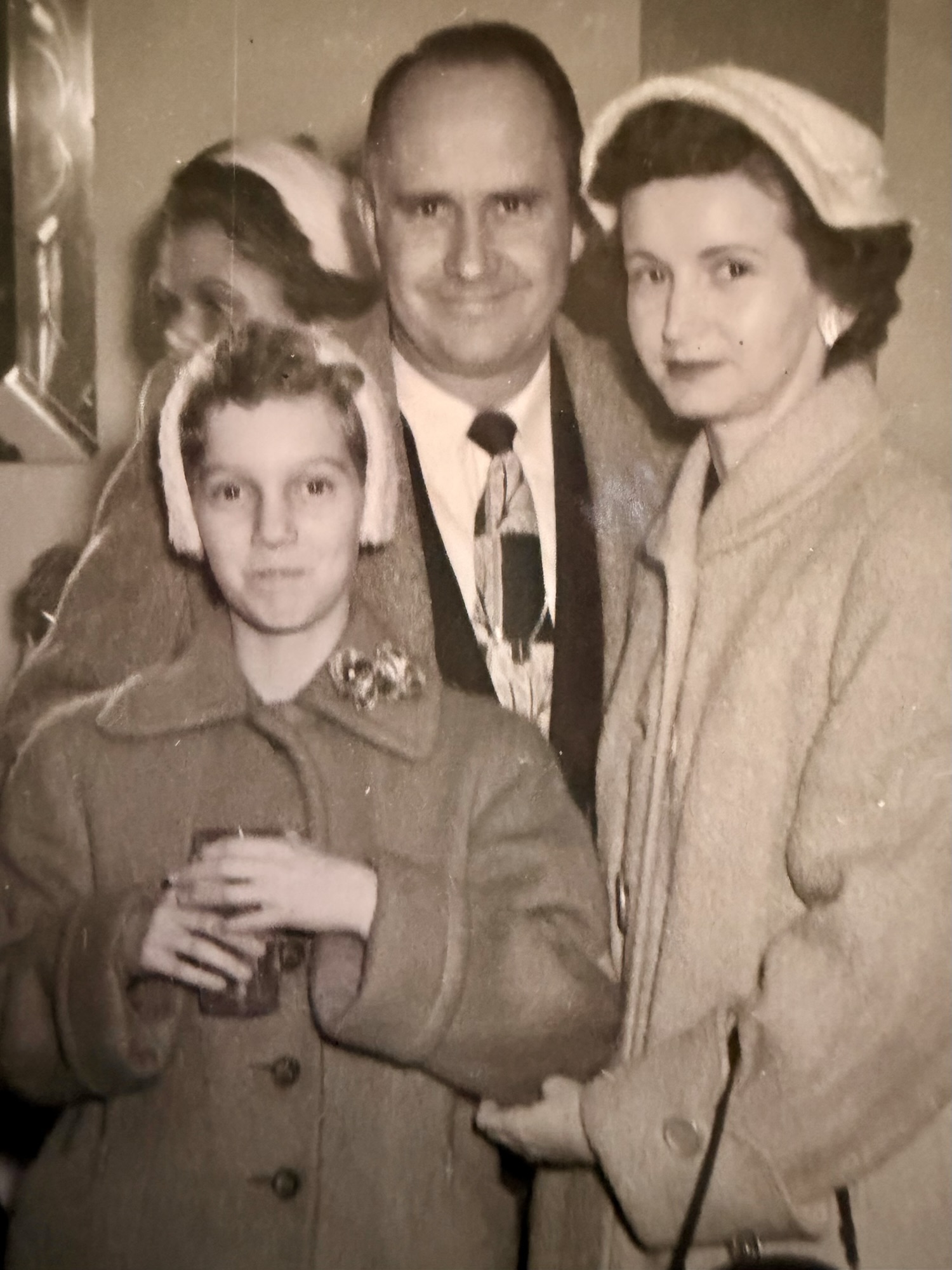
July 2, 2026
Mom introduced me to her hospice nurse, Kelly, as the woman who comes to help take care of “her” dad.
Dad was standing between us. Kelly smiled, and together they gently laughed it off.
Dad simply said, “It’s all relative in the moment. She sees me as a father figure one way or another. I’ll take what I can get.”
He said it with acceptance. With humility. Without correcting her.
That one sentence stayed with me.
Perhaps somewhere in the tangled pathways of dementia, Mom still longs for the father she lost so young.
Her dad, Major Wilbur Bowers, served our country during World War II. After suffering a heart attack, he retired early from military service and rebuilt his life selling cars and finding healing on the golf course. But what ultimately claimed his life was agonizing, relentless bone cancer.
Just two weeks before Mom graduated from high school, another heart attack—brought on by the pain from the bone cancer—mercifully ended his suffering.


Eight years earlier, at the age of 12, her older sister, Mary Ann, was laid to rest at the tender age of 20 from a years-long battle with brain cancer.
By the time Nancy crossed the stage to receive her diploma, the family she had known was gone. It was just her, her mother, and her grandmother.

Nancy became the only surviving child.
She faithfully honored her grandmother until her passing, then lovingly cared for her mother until she too was laid to rest with Wilbur and young Marianne at Arlington National Cemetery.
Dad never met Wilbur.
He never knew Mary Ann.
But he knew the grief Nancy carried.
And he loved her anyway.
They were married in 1966, on his birthday, July 23rd.
Dad was a Pastor at Open Bible Baptist Church, and Mom’s soprano voice could move a congregation to tears if Dad’s sermons hadn’t already. Yet, if you asked Mom what she wanted most in life, she simply wanted to be a mother.

Their first daughter, Marianne, was born on December 1, 1968, in Fairfax, Virginia. She was affectionately named after Mom’s sister, Mary Ann.
Soon afterward, Dad was accepted to Dallas Theological Seminary. With a baby in tow, they packed everything they owned and moved to Dallas, Texas.
I arrived on September 11, 1970.
Melanie followed on August 1, 1972.
Daniel completed our family on April 21, 1976.
Dad honored Mom’s desire to stay home with us. She babysat other children and taught piano lessons while Dad attended seminary full-time and worked two jobs.

As children, we never felt the weight of how hard they must have worked. We simply knew we were loved. Dad often tells stories about support letters arriving in the mailbox at exactly the right moment—just enough money to pay the rent, buy groceries, or cover another unexpected expense.

Again and again, God provided. When Daniel Jr. was just a few months old, my parents packed up their growing family and moved back to Virginia! Mom was so happy to be closer to her own mother in Arlington. At the same time, my father, accepted a new position as a Theology professor at Liberty Baptist College, in their new Theological Seminary. LBC is now known as Liberty University.
As David wrote in Psalm 150, and their grandson, Cody would echo daily, “Praise the LORD” was heard continuously around our home.
Nearly sixty years have passed since they exchanged wedding vows.

They’ve built a lifetime of friendships, ministry, and memories.
Then, in 2024, at the encouragement of their granddaughter Holly, Dad began keeping a journal.
Mom had just celebrated her 80th birthday. She was entering her fourth year of cognitive decline.


Dad’s first words in his journal read, “No doubt her spinal surgery in 2020 hastened the assault on her mind.”
Then he added words that still take my breath away:
“Her war of attrition is measured in inches, not miles. Of this I have not tried to record to date. Today convinced me I should at least begin. The war is on.”
One morning at breakfast, Mom walked into the room rubbing her head.
She was frightened.
“I don’t know where anything is.”
“My mind won’t think.”
“Where are my things?”
“What’s wrong with my mind?”
Dad wrote:
“Her face was etched with fear. I lost it. The tears just came and I couldn’t stop the flow. I still can’t as I write these words.”
Later Mom quietly said, “I guess some days I’m just sad.”
Dad asked why.
Then he confessed in his journal:
“I didn’t want to say the reason. In my mind I was thinking, ‘It’s complicated.’ The scars are not visible from outside. It’s more like the tide going out. But this time, we won’t see the tide come back in.”
As if burying her own sister, then father, grandmother, and mother weren’t enough, Mom would one day experience every parent’s deepest sorrow.
Her first born daughter, Marianne (and Holly’s mother) —named after the sister she had loved so dearly—died suddenly from a brain aneurysm in 2021.


Grief has marked every chapter of her life.
As I sat reading Dad’s journal, tears were dropping all over the very first page like fresh rain, and I realized I wasn’t simply reading a diary.
I was cradling a sacred scroll.


One entry especially captured the woman dementia cannot erase.
Dad wrote:
“She attaches herself quickly to children, and they, in turn, respond in kind to her sincere kindness. I think when we get to the end of ourselves, it is there that God will intervene to work in and through us. I think sometimes I am witness to the presence of the Holy Spirit in raw. She is just carried along where there are no footprints in the sand. One of these days, like Elijah, He’s going to carry her all the way home.”

Those words prepared me for something beautiful.
I opened the door to greet Rev. Ron Davidson, the first friend to visit Dad in-person this year, other than Chaplain Bob.
It was a gift to watch two aging servants of God sit together praising the Lord while walking through different seasons of suffering.
Rev. Davidson had just recovered from surgery repairing a broken ankle and nine weeks in a wheelchair. He had only recently gotten back on his feet when he happened to read one of my blog posts online.
I’m no longer on social media, but somehow those words found him.
Within twenty-four hours, he climbed into his truck and drove to my parents’ home.
Mom was taking one of her long afternoon naps, giving the two old friends uninterrupted time to pray, laugh, remember, and simply be together.
Caregiver burnout is real.
Dad’s well was running dry.
And just when he needed it most, God sent a faithful friend to his front door.

Looking back, I can’t help but think about Dad’s words when Mom introduced me as the woman who helps care for “her” dad.
Maybe she wasn’t entirely wrong.
For nearly sixty years, Dad has protected her, provided for her, comforted her, and carried burdens she could no longer carry herself.
Today, dementia has blurred the titles.
Husband.
Father.
Friend.
Caretaker.
But love doesn’t need perfect memory to recognize faithfulness.
Dad smiled and said, “I’ll take what I can get.”
After all these years, I think that’s exactly what love looks like.
