August 12, 2026
August is always the hottest month of the year in Virginia. We feel the humidity pressing against our skin, and when the rains don’t come, we feel the drought of summer drying our human bodies. The earth becomes thirsty. The grass loses its green. The heat pulls moisture from every living thing.
As we age, our bodies begin to reflect that same aging process. We become more fragile, more dependent, and little less able to do the things we once did without thinking — a gradual drying of strength, mobility, memory, and independence.
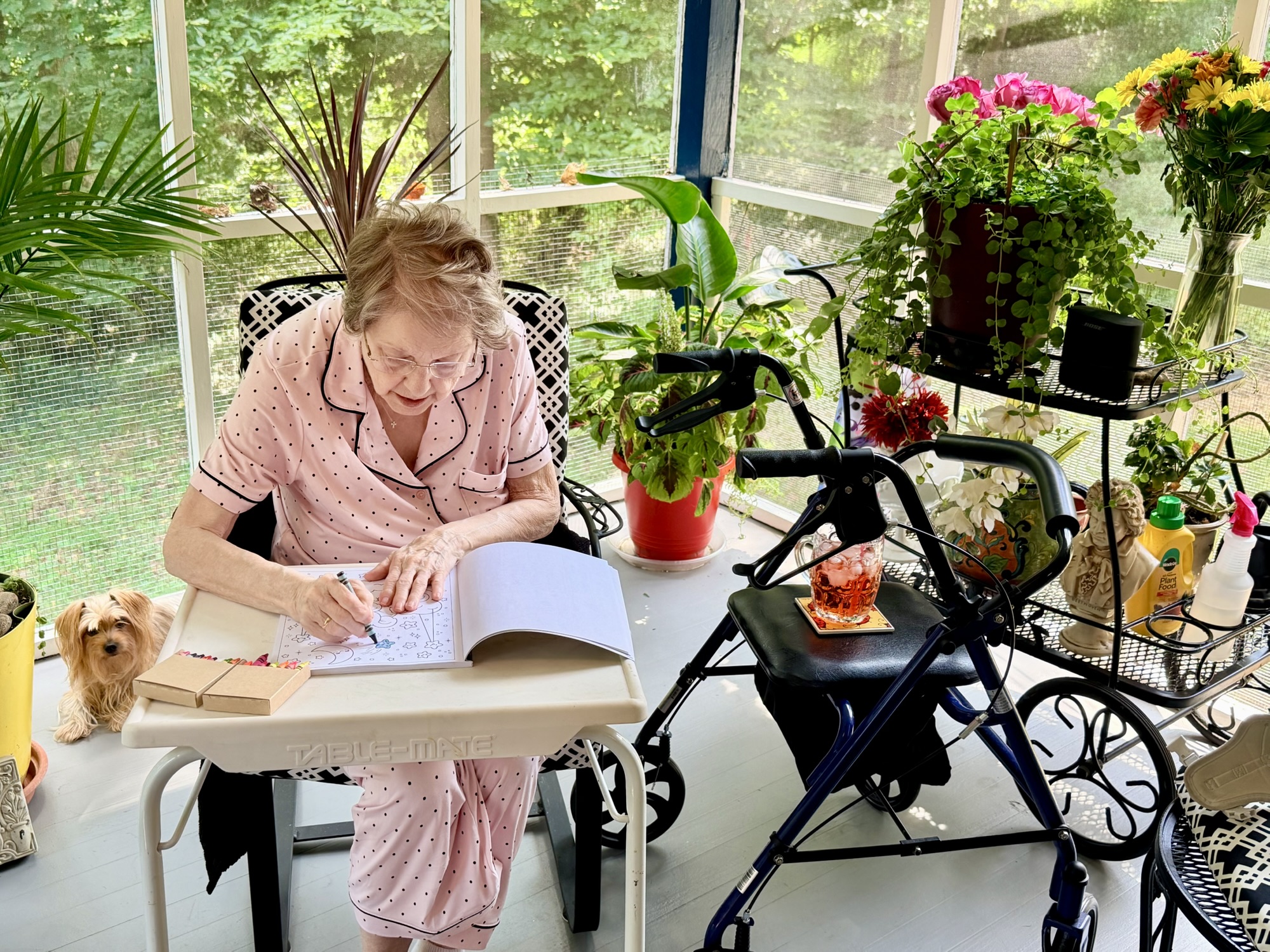
For the past five months, I have been shifting my focus toward the care of my mother, and also my father. In this season, I have been reminded in a very personal way of the importance of honoring our parents.
I have always believed that I have a natural gift of empathy. But empathy feels different when it moves from something you feel into something you must live. It becomes less about imagining what another person is experiencing and more about entering someone else’s world with patience, tenderness, and grace.
My parents have been influencers long before that word became popular.
Their influence has come through their living testimony.
Sixty faithful years of marriage.
Four children.
A home that was never just a house, but a place where people gathered.
They taught us, mostly by example, to turn our hearts toward Heaven. They taught us that when life becomes hopeless, scary, or anxious, there is still a God who is near. They taught us to look beyond what we can see and to trust the presence of God even when circumstances tell us otherwise.
My parents also made it their business to be about their children’s business. They knew our friends. They found ways to become friends with our friends. They opened their home for fellowship and never seemed to need much of an invitation to make someone feel welcome.
A stranger could walk through their door and somehow become a friend before the end of the day.
That was their gift.
Their world was never small because their hearts were never small.


And yet, these past five months have felt like a season when their world has become smaller and smaller.
The places they go.
The people they see.
The things they remember.
The conversations they can follow.
The independence they once took for granted.
Dementia has a way of shrinking a person’s physical world while also creating a world that those of us who love them cannot always enter.
Our friend, Reverend Ron reminded me about Elijah. Elijah stood in a time of drought—not simply a physical drought, but a spiritual one. Israel had wandered away from God. Everything looked dry.
And yet God was still present.
God was still speaking.
God was still providing.
God was still working.
That has become something I need to remember as I walk through this season with my mother.
Because dementia can feel like a drought.
There are days when memories that once seemed permanent disappear. There are conversations that cannot be held onto. There are moments when I look at my mother and see the woman I have always known, and then there are moments when the disease seems to pull her farther away.
This season is teaching me that God’s presence does not depend upon our ability to remember Him.
My mother may forget a conversation.
She may forget what happened yesterday.
She may forget what she just said.
But God does not forget her.
And that is part of the deeper lesson of Elijah.
When the brook dried up, God had not dried up.
When the land was thirsty, God was not absent.
When Elijah became exhausted and afraid, God did not abandon him.
God fed him.
God allowed him to rest.
God spoke to him.
And when Elijah thought he was alone, God reminded him that he was not.
I think about that often now. Because caregiving can be its own kind of wilderness.
There are days when Dad is tired.
Days when Dad is anxious.
Days when Dad and I wonder how much longer this season will last.

Days when our family grieves the mother who is still physically here but is changing in ways we cannot stop.
And yet, the invitation is not to fix what we cannot fix. The invitation is to remain present.
To honor.
To listen.
To love.
To remember for her when she cannot remember for herself.
To become, the keeper of memories that dementia is taking away.
And then I remember something Dad did.
Last month, when everything around us seemed dry and the possibility of growing anything seemed almost impossible, Dad dug a trench and planted grass.


It seemed like an unlikely thing to do in a drought.
Why plant grass when the ground is dry?
Why invest in something when there isn’t enough rain?
Why believe that something will grow when everything around you says it won’t?
But Dad did it anyway.
He dug.
He planted.
He waited.
And the morning dew and rains came.
What once looked like an impossible place to grow anything has begun to tell a different story.
The trench Dad dug has become beautiful, and a place for the rain to flow.

And the very place that looked barren has become green.

There is something about that little hillside that feels like a parable.
Faith sometimes looks foolish in a drought.
Planting in a dry season can seem pointless.
But we don’t always know when the rain is coming. The weatherman isn’t a prophet!
The work of faith is simple – plant anyway.


That feels especially meaningful as we continue celebrating Mom’s birthday.
She has been honored with flowers from friends—some of them people she and Dad never expected to see.
People from different seasons of their lives have appeared.
People they haven’t seen in a long time.
People who still remember.
People who still care.
And this is another kind of rain.
In a season when Mom and Dad’s physical world seems to be getting smaller, their circle of love has somehow become visible again.
Flowers have arrived.
Friends have appeared.
Memories have been stirred.
Love has poured in from places we weren’t expecting.


The Lord is close to the brokenhearted.
And in this season of drought, that outpouring of love feels like fresh rain.
That is what God is teaching me.
The rain doesn’t always come in the way we expect.
It comes as a friend walking through the door.
It comes as flowers delivered for a birthday.
It comes as a memory that suddenly returns.
It comes as someone saying, “I remember your mother.”
It comes as a hillside of baby grass where there once seemed to be nothing but dry earth.
And it comes as strength for one more day.
These are the days of Elijah.
Days of drought.
Days of faith.
Days of waiting.
Days of unexpected provision.
Days when God reminds us that He is still God even when the circumstances look barren.
We don’t need to see the whole storm to know that God is moving.
We only need to notice the little cloud.
The flowers.
The grass.
The friend who shows up.
The unexpected phone call.
The moment of laughter.
And the strength to get through another difficult day.
The quiet assurance that says, God is still here.
My parents spent sixty years teaching us to turn our hearts toward Heaven.
Now, in this season, I am learning to do the same thing in a deeper way.
Not because the season is easy. But because it isn’t.
Not because we understand it. But because we don’t.
Not because we can fix it. But because we can’t.
We can only love.
We can honor.
We can remember.
We can plant.
We can wait.
And we can watch for the rain.
The drought does not have the final word.
The hillside is green.
The flowers are blooming.
Friends are coming.
Love is being poured out.
And somewhere in the middle of all of it, I hear the quiet reminder:
The Lord is close to the brokenhearted.
So I will keep turning my heart toward Heaven.
I will keep believing that even in the driest season, something can still grow.
And when the rain comes, I want to remember that God was there in the drought too.

