September 4, 2026
Every morning, Dad begins the day by setting the table for breakfast.
It is more than setting a table. It is a ritual.
And when you love someone with dementia, you learn that rituals matter. They provide a familiar pathway through a world that can sometimes feel uncertain. When everything is in its proper place, the morning has a rhythm. A rhythm that can be trusted.
Dad thoughtfully prepares Mom’s place.
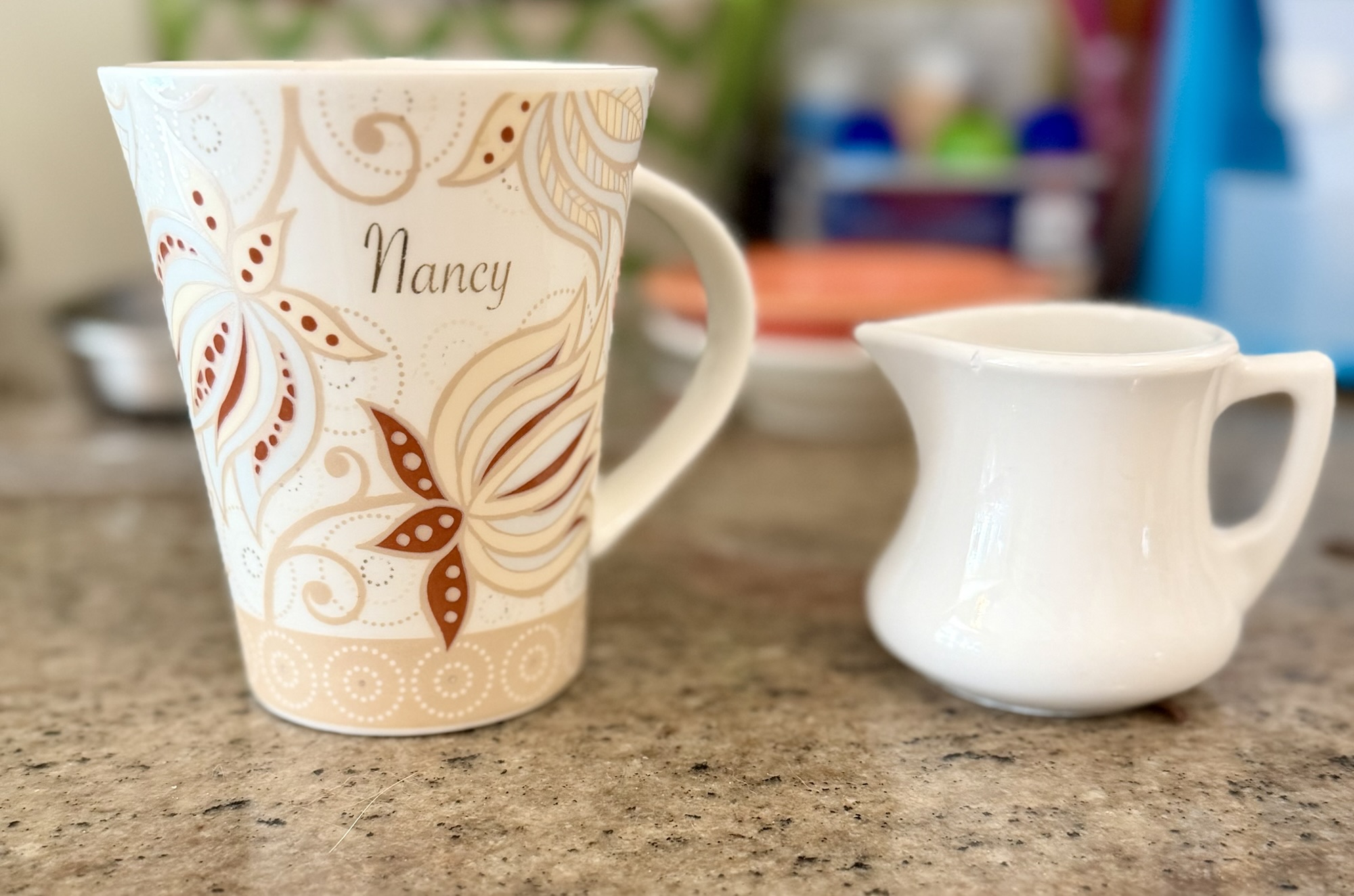
The placemats match. The silverware is placed exactly where it belongs, resting on a neatly folded napkin. Sugar packets are positioned in the right corner, waiting beside the warm mug of hot water brewing a fresh cup of English tea. The cream is poured into a small ceramic creamer with a handle and placed on an ice pack so it will remain chilled.
Her bowl and plate are set. Her food is placed on the table.
Everything is ready.
Then Mom makes her way into the dining room, trusting that the familiar things she needs will be there waiting for her as she begins her day.
Because if something is missing, even something small, it can interrupt the sequence. She may lose her focus. She may forget what she is doing or why she came into the room.
Over the past two weeks, Dad began noticing something different.
The sugar packets were still sitting unopened beside her tea.
“Nancy, put the sugar in your tea,” he gently reminded her.
“Oh, yes. Okay.”
She picked up the first packet, opened it, and poured the sugar into her cereal.
Dad leaned over and graciously finished sweetening her tea.
The next day, the same thing happened.
And the next.
And the next.
Something that has been a staple of Mom’s entire life—something she has done almost automatically for as long as she can remember—has become something she can no longer do without help.
If Mom began enjoying her first cup of hot tea around the age of ten or twelve, perhaps sitting beside her own mother, she has had somewhere around 25,000 days of beginning her mornings this way.
Twenty-five thousand mornings.
Twenty-five thousand cups of tea.
Always made the same way.
And now she cannot remember how to make it.
Dementia has taken something so ordinary and made it difficult.
But here is what dementia has not taken.
Mom still looks at Dad without fear.
She trusts him.
She trusts him to be there. She trusts him to know what comes next. She trusts him to sit beside her and share the morning meal.
It is only when Dad is not close by that the world can suddenly feel frightening.
On Wednesday, Dad had to run some errands. Within minutes of him driving away, Mom noticed his absence.
It was lunchtime, and I was able to give her a small sandwich.

But she grew restless.
I opened her coloring book and laid out her crayons, hoping to give her something familiar to focus on. I turned on her music.

Music has always brought Mom comfort.
Soon she began to cry.
“I’m looking for my husband,” she said.


I assured her that he was just at the store and would be home soon.
And then, just like that, Dad pulled into the driveway, and everything changed.
His presence alone changes the atmosphere of the entire house.
He walked through the door carrying some new lounge wear for her, and watching the two of them together was like witnessing love in live-action.
Only when Dad gently asked her why she had been crying did she allow the tears to come again.
She told him how much she loved him.
Then she gently leaned toward his hand, cupped it between both of hers, and kissed it.
The tears disappeared.
Her safety net was safely surrounding her again.
And just like that, Mom returned to joy.
She began singing.
A dear friend, Patricia, arrived minutes later, and soon the room was filled with laughter, coloring, music, and friendship.
They share a space that very few people get to enter.
Mom looked at Patricia and said,
“You are so beautiful!”
And I thought: What a gift.
A gift from God arriving at just the right moment to remind Mom—and all of us—of beauty.
Mom’s angelic singing filled the room again.
These are the moments I cherish most.
Because dementia can make us believe that every difficult moment is the beginning of another loss. We brace ourselves for what will disappear next. We grieve the things Mom once knew how to do without thinking.
And then something happens.
A hand is held.
A kiss is given.
A song is sung.
A husband comes home.
A friend walks through the door.
And suddenly, love speaks.
It speaks without needing memory.
It speaks without needing words.
It speaks through a familiar hand, a gentle presence, a kiss, a song, a smile.
The clouds part.
For a little while, Mom’s “burdens are thrown away. And she is happy all the day.“

Memory may be disappearing, but love is still finding its way through.
And that is the greatest ritual of all.
When Mom can no longer remember how to make her tea, she can still recognize the hand that helps her. When she cannot understand why she is crying, she can still feel safe when Dad comes home. When the details of life become confusing, love remains clear.
She is being held by love.
She is being held by her husband.
And she is being held by God.
As Isaiah reminds us:
“Even to your old age and gray hairs I am He, I am He who will sustain you. I have made you and I will carry you; I will sustain you and I will rescue you.”
— Isaiah 46:4
So when memory fails, may we remember for her.
When she becomes afraid, may we be her safe place.
When she forgets the ritual, may we gently complete it.
And when the clouds part and she begins to sing, may we recognize those moments for what they are: little glimpses of grace.
Dementia may take pieces of the life she once knew, but it cannot take away the love that surrounds her.
That is what she will always know.
Love.

