October 6, 2026
The weather has cooled this week, carrying with it the familiar change of season that autumn brings. There is a certain tenderness in the air this time of year, as if the world itself is learning how to let go.
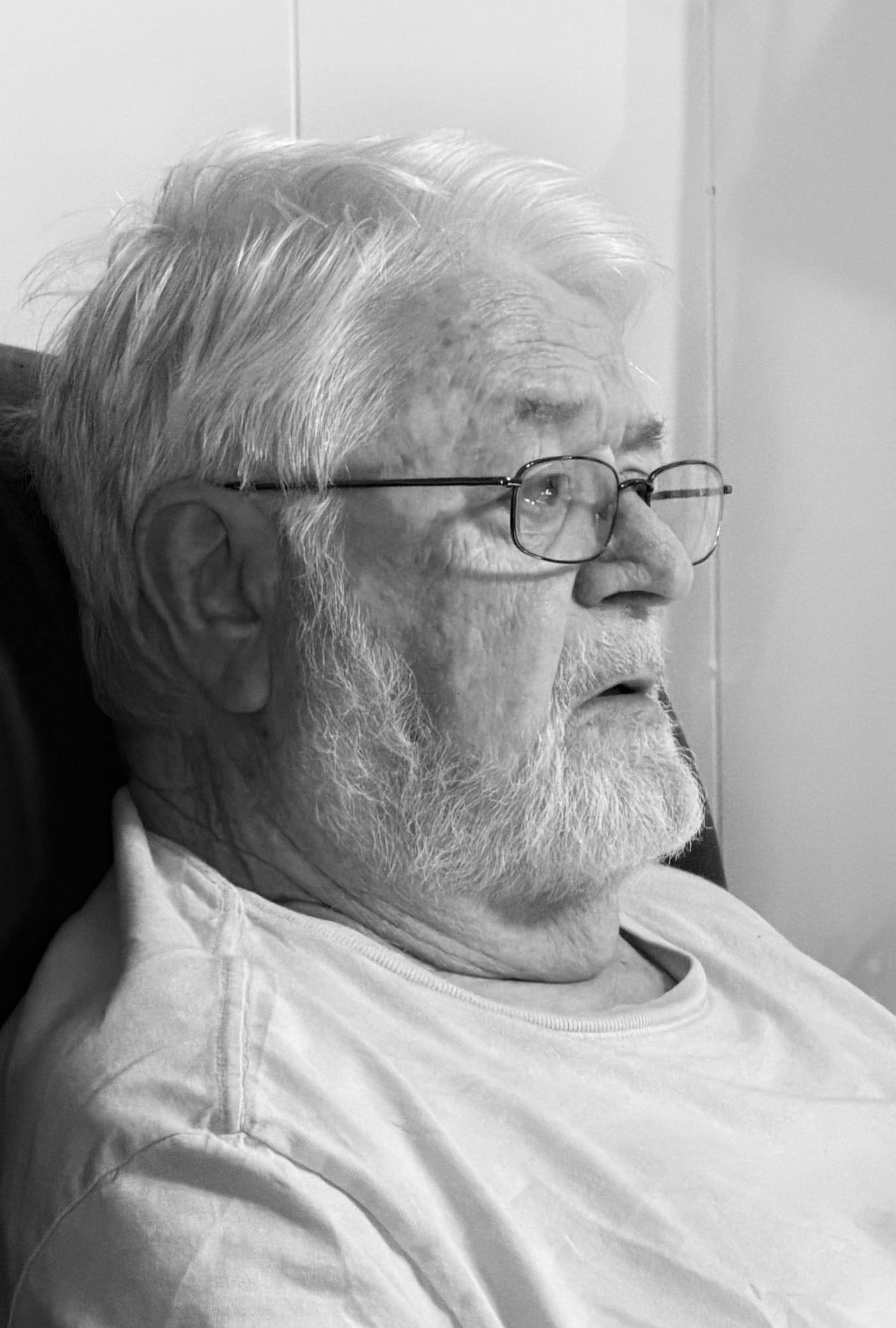
I arrived at my parents’ home this morning, and met Dad at the entrance, Dixie’s leash in his hand as she was beginning her morning ritual of sniffing, exploring, and finding just the right places to squat. Dad wore his favorite mustard-yellow Camp Butler T-shirt and a pair of lightweight cotton pants, both oversized and comfortable enough for the kind of embrace that ends with settling into his recliner.
The breeze carried a chill, and the leaves had begun their graceful descent. They glided through the air with the effortless spin of a ballerina performing her final dance before rising for a curtain call. Up the street, a rooster sounded like the lone audience member applauding the colorful carpet spreading across the dirt and grass.
But Dad was quiet.
I have learned that silence has its own language, especially when grief lives just beneath the surface. I could tell he had something to say, something too heavy to lift into words just yet. So I gently released Dixie’s leash from his hand and gave him a moment alone in the cool morning air.
He raised his face toward the wind, allowing it to dry his tears. He inhaled the presence of God and exhaled his grief.
I didn’t ask him what was wrong. I didn’t insist that he look at me or explain what he was feeling. I didn’t try to fill the silence with words that might have been too small for the moment.
I simply gave him room to abide.
Sometimes love looks less like speaking and more like knowing when not to. Sometimes the kindest thing we can offer another person is permission to feel what they cannot yet explain.
I walked with Dixie as she pranced through the yard, stopping here and there to attend to the important business of being a dog. She eventually skipped back toward the house, following Dad’s shadow until he turned down the hallway to wake Mom.
Inside, the table was set. Her hot tea was poured, and her seat was waiting to receive her.
Another morning. Another beginning.

For several hours, Dad could not bring himself to tell me what had happened the night before. It was as though the words needed time to settle, just as the autumn leaves needed time to find their resting place.
Then, finally, he told me.
Mom has experienced two lucid moments this month. Each episode lasts only a few moments, but the emotions left behind can linger for hours, sometimes days. These brief windows of clarity seem to open a door into a room we thought dementia had permanently closed. For a moment, the fog lifts, recognition returns, and the person we have been longing to reach seems to find her way back to us.
And then, just as quickly, the moment passes.
Last night, Mom looked at Dad and began to cry.
“I’m so sorry. I don’t know what’s happening to me. I don’t like it.”
She kept reaching for his hand.
Dad told me that she seemed to be looking at him as though she had not initially remembered who he was. Then something shifted. Recognition returned. Love found its way through a place where memory could no longer lead her.
“She kept repeating, ‘I love you, and I’ve always loved you,’” Dad said.
I can only imagine what it must be like to stand in that moment as her husband.
What do you say to someone who is almost inconsolable? How do you explain a disease that has taken so much from the woman you love, while she is suddenly aware enough to grieve what is happening to her? How do you comfort someone who is frightened by a reality neither of you chose?
There are no rehearsed words for a moment like that. No perfect response. No sentence capable of making the disease disappear.
There is only a hand to hold, a heart to break alongside hers, and the promise of staying.
Dad had hoped that by morning, Mom would no longer remember the episode. Perhaps the day would begin again without the pain of the night before.
And, in a way, it did.
Once she was awakened for breakfast, the day began to unfold as it so often does. The table was ready. The tea was warm. The familiar rhythms of morning resumed, while the weight of the previous evening remained with Dad.

Dementia has a way of making time feel strangely uneven. One person may carry the memories of a difficult night while the other begins the morning without them. One heart remembers the tears, the questions, and the desperate reaching for a familiar hand. The other may have no recollection of what happened just hours before.
Yet love remains present in both.
I’ve been reading articles about terminal lucidity, a term used to describe unexpected periods of mental clarity in people with severe cognitive impairment, sometimes reported near the end of life. Researchers continue to explore these experiences, though much remains unknown about why they occur and what they mean. I cannot say that Mom’s moments are terminal lucidity, nor can I know what the moments mean for her future.
I only know that when they happen, they leave an impression that is difficult to describe.
They are beautiful, because for a moment something familiar returns.
They are heartbreaking, because that same moment may bring an awareness of what has been lost.
And they are sacred, because they remind us that there is still a person here, still a heart capable of reaching for love, even when the pathways of memory have become difficult to navigate.
The greatest temptation is to spend my days searching for explanations. I want to understand the why, the how, and the when. I want a map through the uncertainty, a signpost pointing toward solid ground.
But sometimes, all I can do is walk the path before me.
I have also been reflecting about the compassionate care offered by organizations like Gentle Shepherd Hospice. Their support has been a guiding light for my parents, particularly when Dad’s strength is running low. There are days when he no longer has the endurance to turn on the light and begin the same day all over again. On those days, compassionate caregivers help carry what one person was never meant to carry alone.
There is dignity in receiving help. There is grace in allowing someone else to step into the wilderness with you.
No one likes being alone in a wilderness. Even worse is being lost in one, unsure of the way forward and too exhausted to keep searching for the trail.
Yet this is where I have watched the Lord meet my parents time and again.
He has sustained them throughout their lives, through seasons of joy and seasons of sorrow. And now, in this unfamiliar landscape of dementia, He continues to sustain Dad like daily bread: enough for today, enough for the next step, enough for the morning that lies ahead.

Not necessarily enough to understand everything.
Not necessarily enough to know what tomorrow will bring.
But enough to keep going.
I am reminded of the words in 1 Corinthians 13:4–7, which describe a love that is patient and kind, a love that does not envy or boast, a love that is not proud or self-seeking. A love that is not easily angered and keeps no record of wrongs. A love that does not delight in evil but rejoices with the truth. A love that always protects, always trusts, always hopes, and always perseveres.
I have read those words many times throughout my life, but watching my parents walk through dementia has given them a different kind of weight.
Love is patient when the same question is asked for the tenth time.
Love is kind when confusion replaces recognition.
Love does not keep a record of the things dementia has taken away. It does not measure a person’s worth by what she can remember or what she can no longer do.
Love protects dignity when independence begins to fade.
Love hopes when answers are scarce.
Love perseveres when the nights are long and the mornings begin again.
And sometimes, love stands in the cool autumn breeze, holding back its questions, allowing tears to fall, and trusting God to meet a weary heart in the silence.
I am learning that no one can be a caretaker for a lifetime all at once. The thought alone is enough to overwhelm even the strongest heart. We were never meant to carry the entire weight of tomorrow while trying to survive today.
But anyone can be a caretaker for a day.

We can offer a meal. We can sit beside someone who is grieving. We can walk the dog, pour the tea, make the phone call, or give a tired caregiver an hour of rest. We can listen without trying to fix what cannot be fixed. We can remind one another that asking for help is not a failure of faith, and needing rest is not a failure of love.
We can show up today.


And when tomorrow comes, we can ask God for the grace to show up again.
Outside, the leaves will continue to turn. They will loosen their hold on the branches and surrender to the breeze, each one falling in its own time. The rooster up the street will find another morning to announce, and Dixie will continue her familiar rounds through the yard. Inside, the tea will be poured, the table will be set, and Dad will do what he has done so many times before: love Mom through another day.
I wish I could tell him that the road ahead will be easy. I cannot.
I wish I could promise that the fog will lift and stay lifted. I cannot.
But I can remind him that he does not have to walk this road alone.
The God who sustained them through all the seasons of their lives has not abandoned them in this one. The same hands that carried them through their younger years are holding them now, even when the way forward seems hidden. And the love that has bound them together through decades of marriage is not erased by a failing memory.
Memory may falter. Words may disappear. Familiar faces may become unfamiliar for a time.
But love is not measured by the ability to remember it.
That is one of the quiet miracles still unfolding in their home: that even when Mom cannot hold every memory, she can still reach for Dad’s hand. And when she does, he is there.
For now, that is enough.
One breath in. One breath out.
One prayer whispered into the wind.
One more morning, met with grace.
And when the autumn leaves have finished their dance and the branches stand bare against the winter sky, may we remember that letting go is not the same as being forsaken. Even in the quietest seasons, roots remain beneath the surface, held by a ground we cannot always see.
May we learn to love patiently, to care compassionately, and to receive each day as a gift rather than a promise.
For the wilderness may be unfamiliar, and the path may be difficult to follow, but we do not have to find our way alone.
God is already there, waiting in the breeze, present in the silence, faithful in the ordinary rituals of a new morning.
And love, by His grace, will keep showing up.
One day at a time. One act of kindness at a time. One season at a time.
Until the leaves fall, the morning comes, and hope rises once more.
