July 30, 2026
Today felt like a symphony.
It began with joy, descended into fear, and, by God’s grace, found its way back to hope.
Our mornings usually follow a familiar rhythm. Breakfast is served, and then comes Mom’s favorite part of the week—her visit with Kelly, her hospice nurse.
To Mom, it’s “Spa Day.”
Kelly fills the room with warmth before she even begins drawing the bath. The warm water eases the relentless arthritis in Mom’s neck. Fresh sheets replace yesterdays. Her hair is gently blow-dried and styled just the way she likes it. Through every step, the two of them giggle together like lifelong girlfriends.

The sound of my mother’s laughter never grows old. It never becomes ordinary. Just twenty-four hours earlier, her home had been filled with another unexpected blessing—a basket overflowing with fresh vegetables from Betty’s garden. Betty, a dear friend from church, and Reverend Davidson stopped by for a visit, bringing far more than tomatoes and squash. They brought conversation, laughter, and prayer into a home that might have otherwise been quiet. Once again, Mom’s laughter reminded me that some of God’s greatest gifts aren’t wrapped in grand gestures, but in faithful people who simply show up.


I think laughter is one of God’s sweetest gifts—a glimpse of heaven tucked into ordinary moments. We were created in His image, and because our God delights, rejoices, and loves, He created us with the ability to laugh. Scripture reminds us,

“A cheerful heart is good medicine, but a crushed spirit dries up the bones.”
— Proverbs 17:22
And again,
“He will yet fill your mouth with laughter and your lips with shouts of joy.”
— Job 8:21
I believe laughter is an intentional dose of God’s medicine. It doesn’t erase suffering, but it reminds us that suffering never gets the final word.
Right on schedule, Kelly finished her visit. Mom blew kisses, wrapped Kelly in one last hug, and waved goodbye as she walked out the door.
Dad and I started talking about lunch while I prepared it. Only a few minutes had passed when everything changed. When I brought her lunch, something was different.
Her hands trembled so much that she couldn’t hold the sandwich. I gently held it for her, and with each bite she struggled to chew and swallow. I blended her a watermelon smoothie and handed it to her with the pink straw that always seems to complete the drink.
The shaking became worse.
I helped her back to bed, tucked the blankets around her, adjusted her pillow, and told Dad something wasn’t right.
We didn’t understand what we were seeing.
Her entire body shook. Her teeth chattered. She clutched her neck in agony. I rubbed arthritis cream into her neck, hoping it would bring relief, but the trembling only intensified.
Then Hospice arrived.
Two nurses walked through our door like rescue had finally found us.
As they assessed Mom….Dad was unraveling.
Mom never took her eyes off him. Even through the pain, her gaze searched only for his face.
He stood beside her holding her hand while the nurses checked her vitals and gently explained what was happening.
This wasn’t a chill causing the shaking.
It was pain. She was having a pain crisis and the nurses carefully explained options on how to manage it. Mom was desperate for rescue.


Holding Dad’s hand, she trusted the promise she has leaned on for sixty years of marriage—that he would help carry her until she could find relief again. I looked at Dad and quietly said, “It feels like she’s climbed all the way to the summit of her pain…and she doesn’t know how to get back down without someone rescuing her.”
Love doesn’t always remove the mountain. Love simply refuses to let someone climb it alone.
Twenty years ago, a friend gave me a simple beanbag neck wrap that could be warmed in the microwave. I drove home, searched until I found it, and hurried back. Thirty minutes later, the warm wrap rested gently around Mom’s neck.
While Dad left for the Pharmacy to pick up some new medicine called in from Hospice, Mom looked at me and quietly asked,
“Will you hold me?”
I stood over the bed beside her. Just as she cradled me as a child, and my daughter cradles her own children through difficult moments, I found myself doing the very same thing for my mother.
Life has a beautiful way of bringing us full circle.
I stroked her arm, and I listened to the gentle hymn of her breathing.

Sunlight peeked through the window until it seemed to wrap around us both.
Slowly…she fell asleep.
I slipped quietly into the nearby chair and simply watched her rest.
I was certain the pain crisis had exhausted every ounce of strength she had.
I was wrong.
She opened her eyes, softly said hello, and asked if I would help her get up.
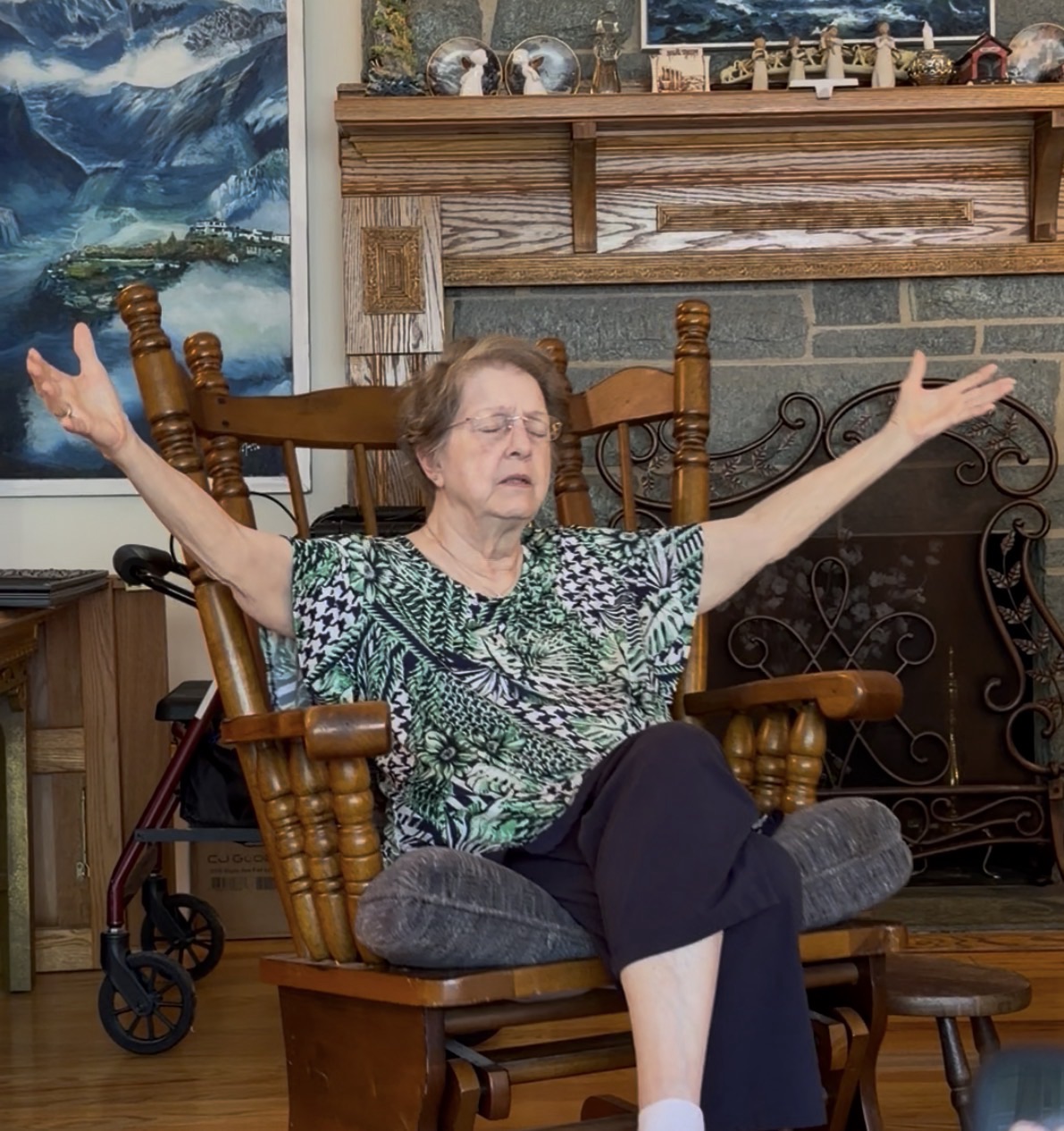
Back to the living room rocking chair we went.
I turned on her playlist of classical music.
As Beethoven filled the room, I realized our day had followed the same pattern as his Fifth Symphony.
Four ominous notes.
A long struggle.
Then, little by little…
the music begins to change.
Not because the hardship disappears.
Because hope enters the score.
Living with dementia is much the same.
We never know what movement comes next.
One moment we’re sitting in warm sunshine.
The next, dark clouds roll over the mountains without warning. The air grows heavy. Thunder crashes. Rain falls. It feels like a battle between darkness and light.
And then…
almost as suddenly as it came…
the storm passes.
The clouds begin to part.
A single ray of sunlight finds its way back into the room.
The music returns.
Hallelujah.
Beethoven’s Fifth doesn’t deny suffering.
It transforms it.
It reminds us that pain is never the final movement.
As believers, we know why.
Our hope isn’t found in perfect health or predictable days.
Our hope is found in Christ, who walks every mountain path with us and promises that every story surrendered to Him will one day resolve into glory.
Today’s symphony began with laughter.
It reached the summit of suffering.
And by evening, somehow, grace had written another ending.
Not because the pain disappeared.
But because love stayed.
And…
that is the most beautiful music of all.
